By Maya Chen, lettering designer and type educator · Checked by Jordan Hale · · How we review content
Key facts
- Cursive letters are easiest to learn in four stroke families (undercurve, loop, downcurve and overcurve), not in A to Z order.
- Handwriting paper marks four heights: the top line, the dashed midline, the baseline and the descender space below it.
- A slant of about 15 to 20 degrees to the right is typical for cursive handwriting.
- Several capitals do not connect to the next letter: O, V and W end high, and in many school models B, D, F, G, I, P, Q, S and T are followed by a pen lift, so lifting the pen there is correct.
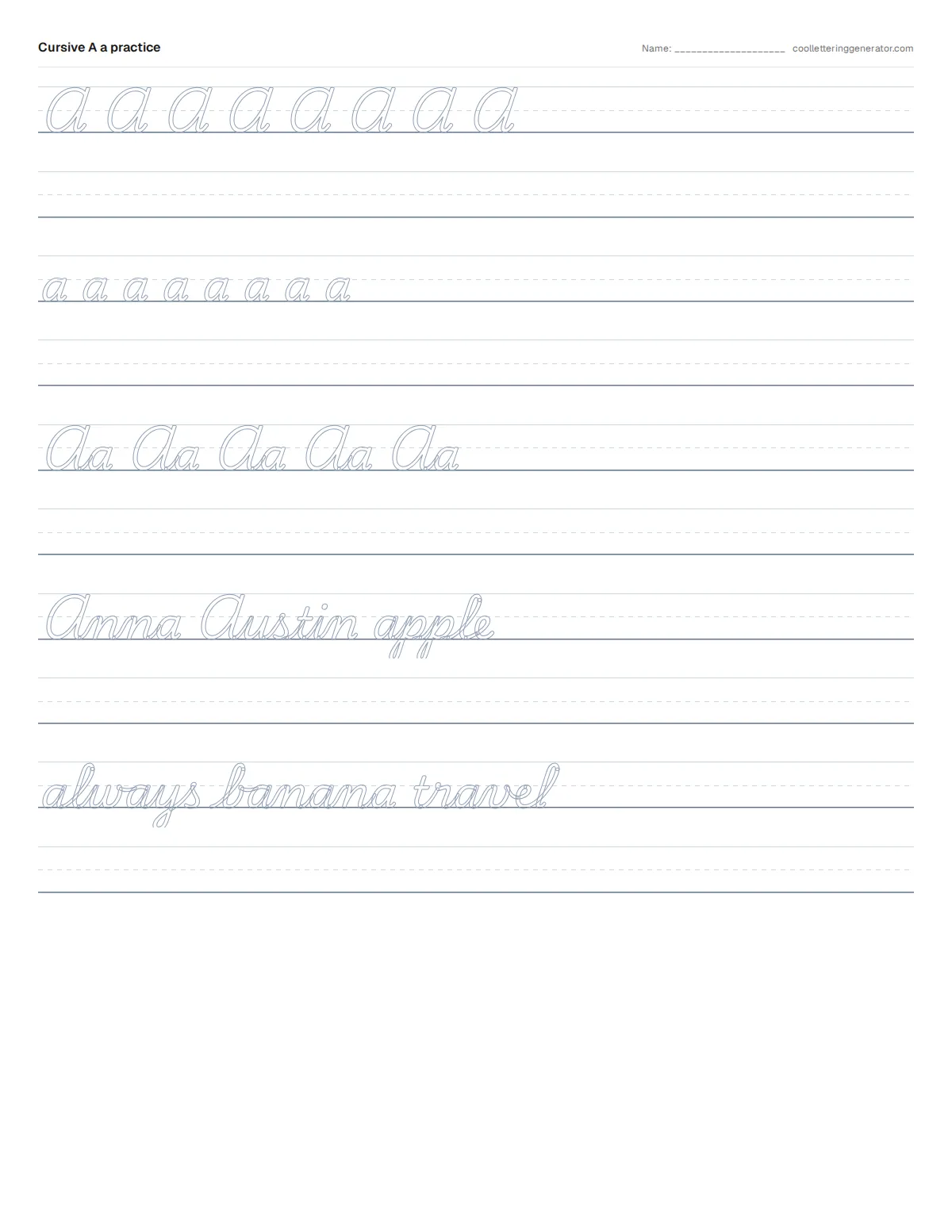
- Every letter page has a Print sheet button that makes a one-page worksheet, sized for US Letter and A4 paper.
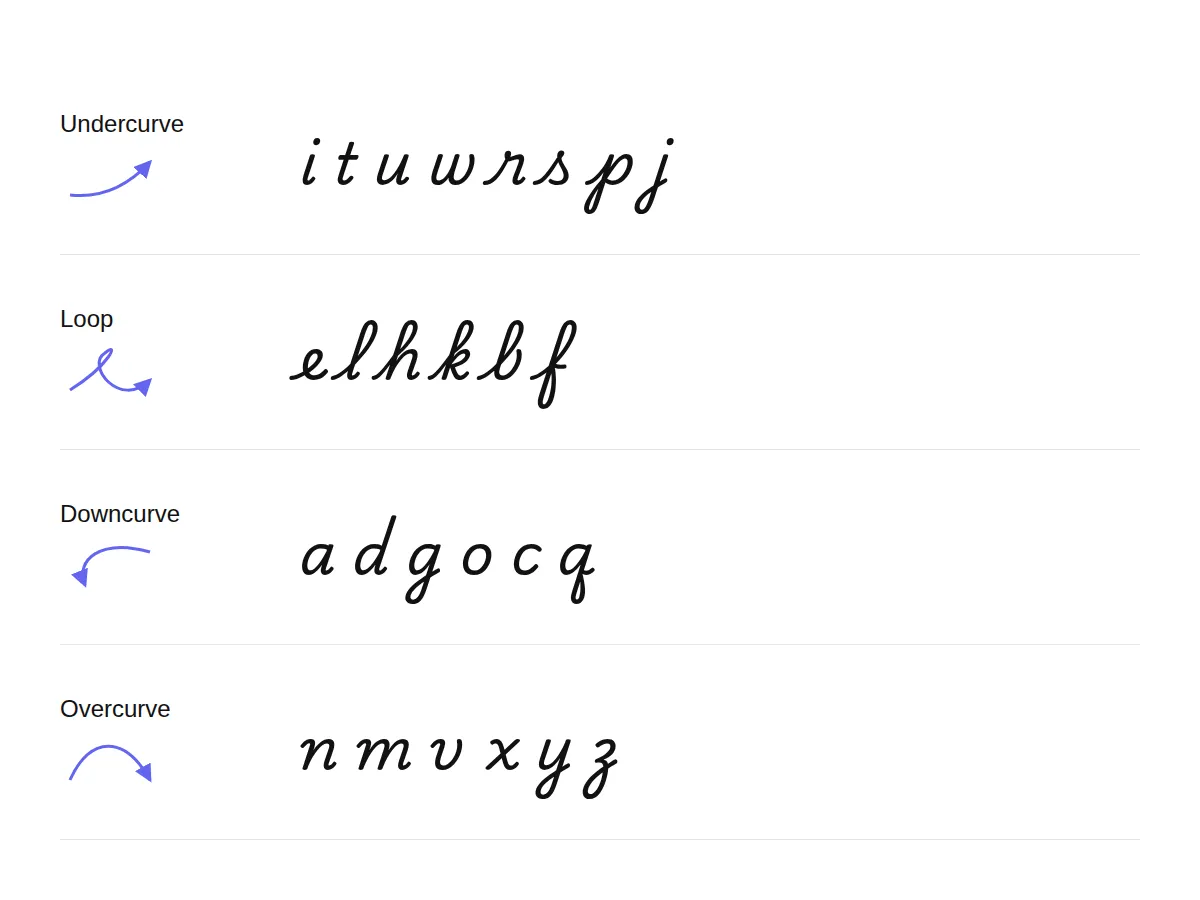
The cursive alphabet has 26 capital letters and 26 lowercase letters. The lowercase letters fall into four stroke families: undercurve (i, t, u, w, r, s, p, j), loop (e, l, h, k, b, f), downcurve (a, d, g, o, c, q) and overcurve (n, m, v, x, y, z).
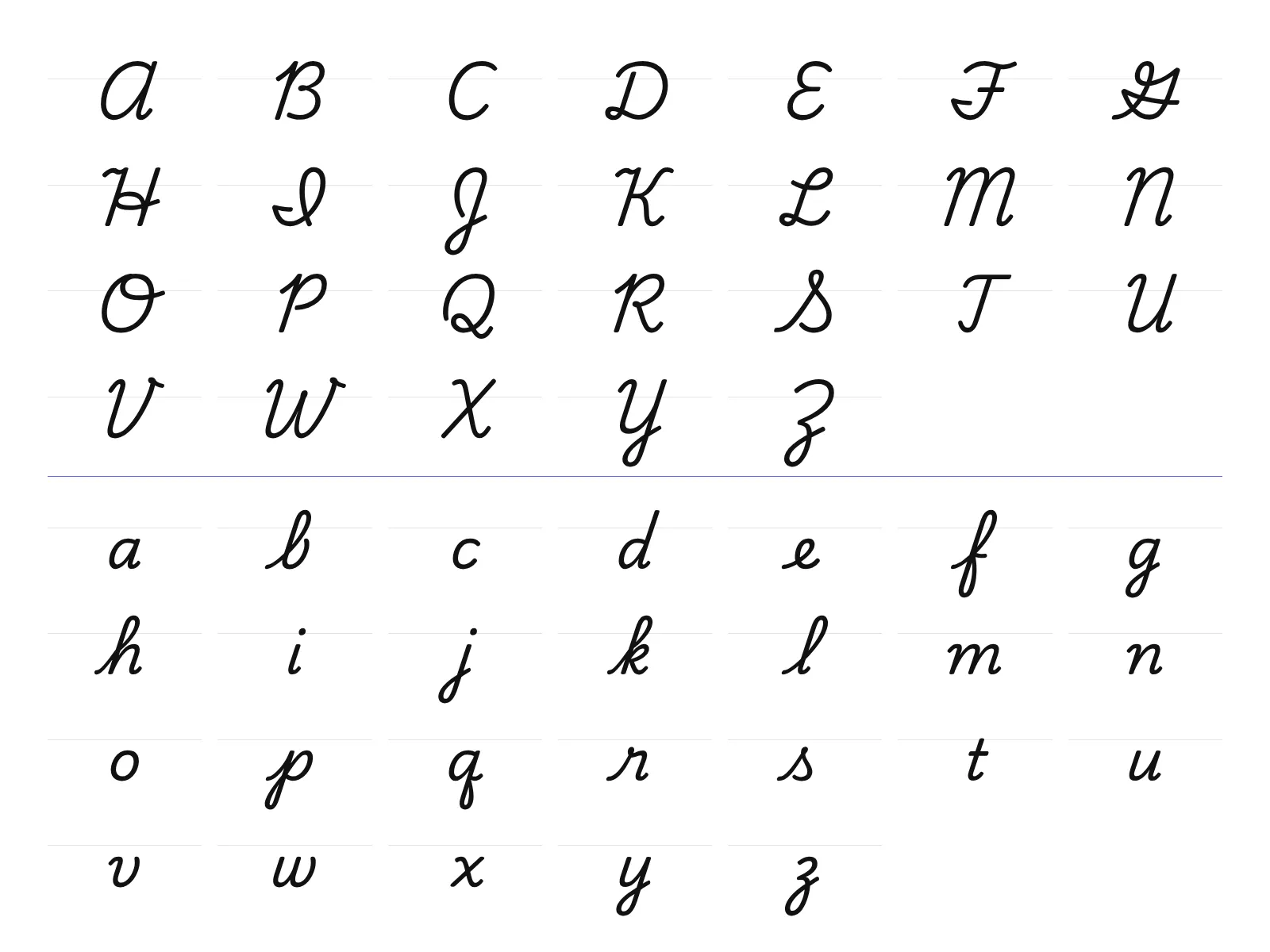
Printable cursive alphabet chart
The chart below puts all 26 capitals and all 26 lowercase letters on one portrait page, each in its own box with faint guide lines. It is sized for a full sheet of paper, so you can print it and keep it beside your practice sheets.
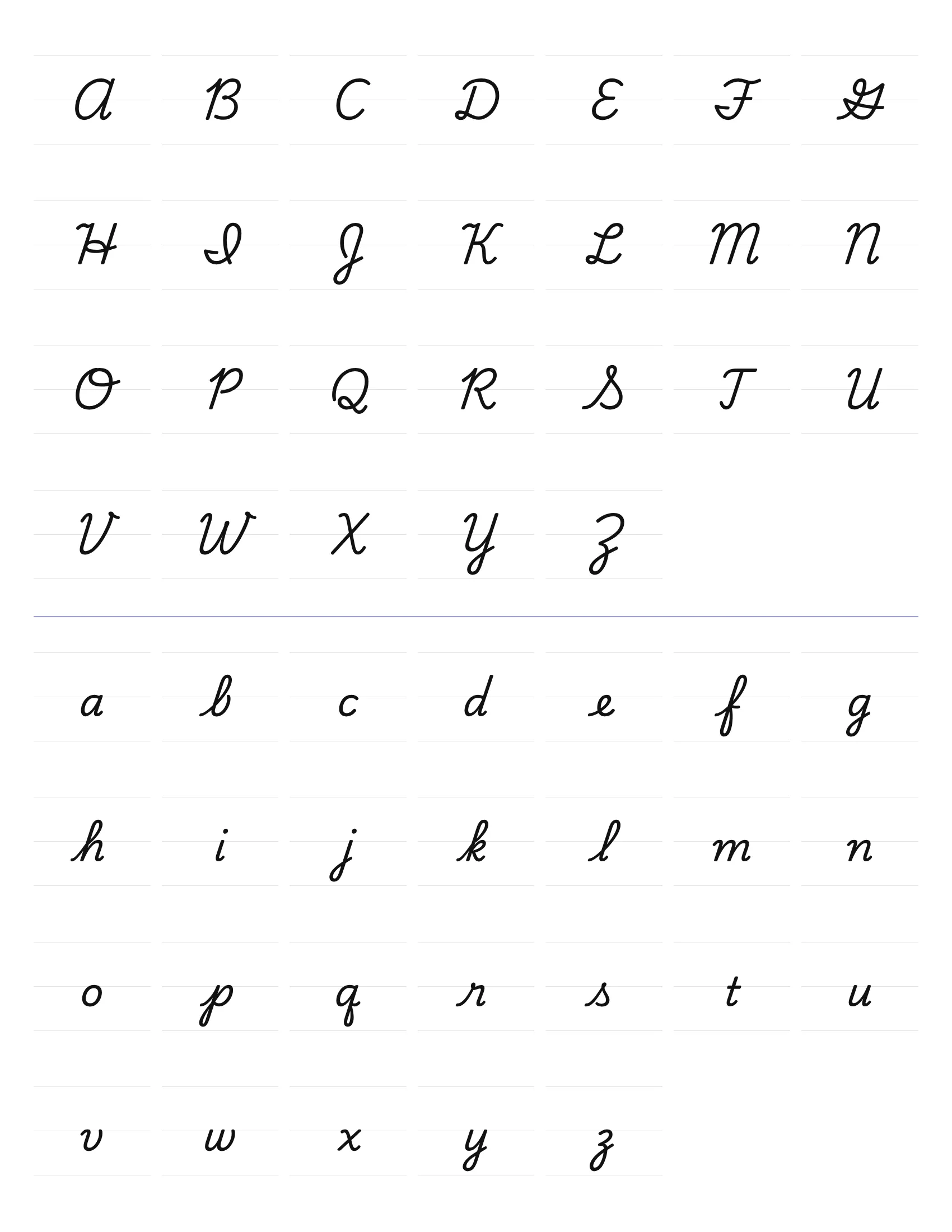
For lined trace-and-write pages, see the cursive worksheets. Each letter page above also has a Print sheet button that makes a one-page worksheet for that letter.
Learn the cursive alphabet in families, not A to Z
The alphabet order is a poor order for learning cursive. Lowercase cursive is built from four basic beginning strokes, and letters that share a stroke are easiest to learn together:
| Family | Beginning stroke | Letters | Practise first |
|---|---|---|---|
| Undercurve | A curved stroke swinging up from the baseline | i, t, u, w, r, s, p, j | i, u, t |
| Loop | An undercurve that keeps rising into a tall loop | e, l, h, k, b, f | e, l |
| Downcurve | Starts at the midline, curving left like a c | a, d, g, o, c, q | c, a, o |
| Overcurve | A hump that rises and curves over to the right | n, m, v, x, y, z | n, m |
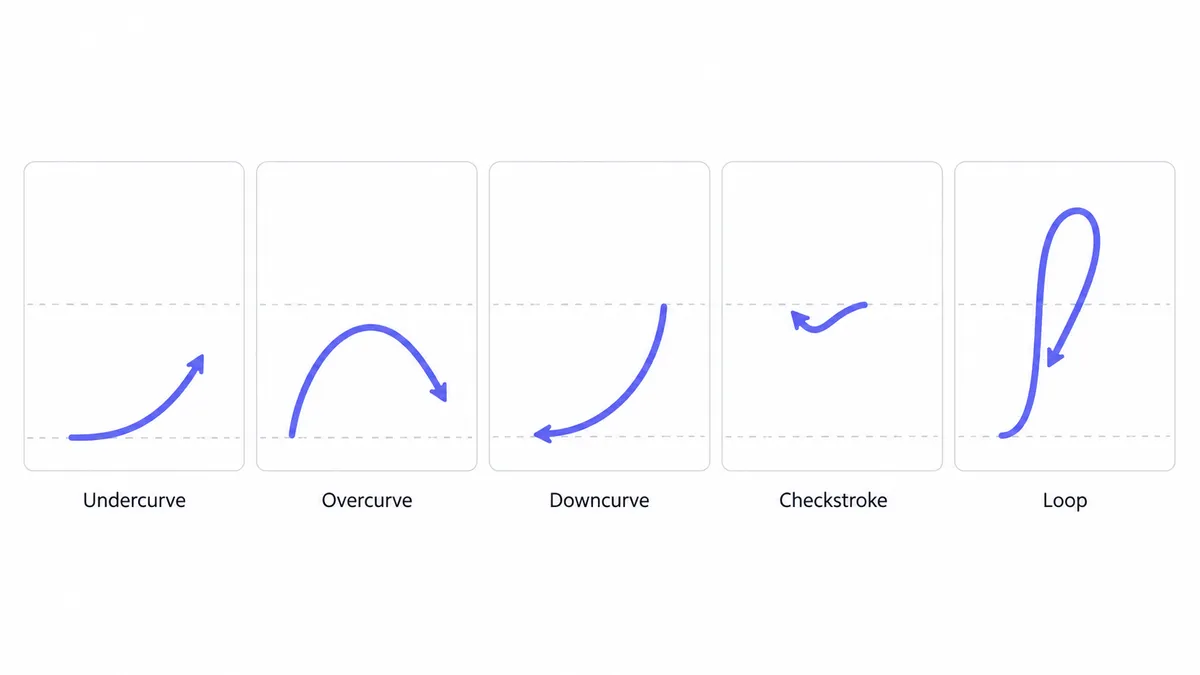
Once a family’s beginning stroke is automatic, every letter in it is mostly the same movement with a different ending. That’s why teachers introduce i, u, t before a, b, c.
What are the four lines that make cursive neat?
Handwriting paper has guide lines for a reason. Each one marks a height your letters should reach:
- Top line: the height of capitals and tall loop letters (l, h, k, b, f).
- Midline (dashed): the height of small letters (a, c, e, m, n…).
- Baseline: where every letter sits.
- Descender space: below the baseline, for the tails of g, j, p, q, y, z and f.
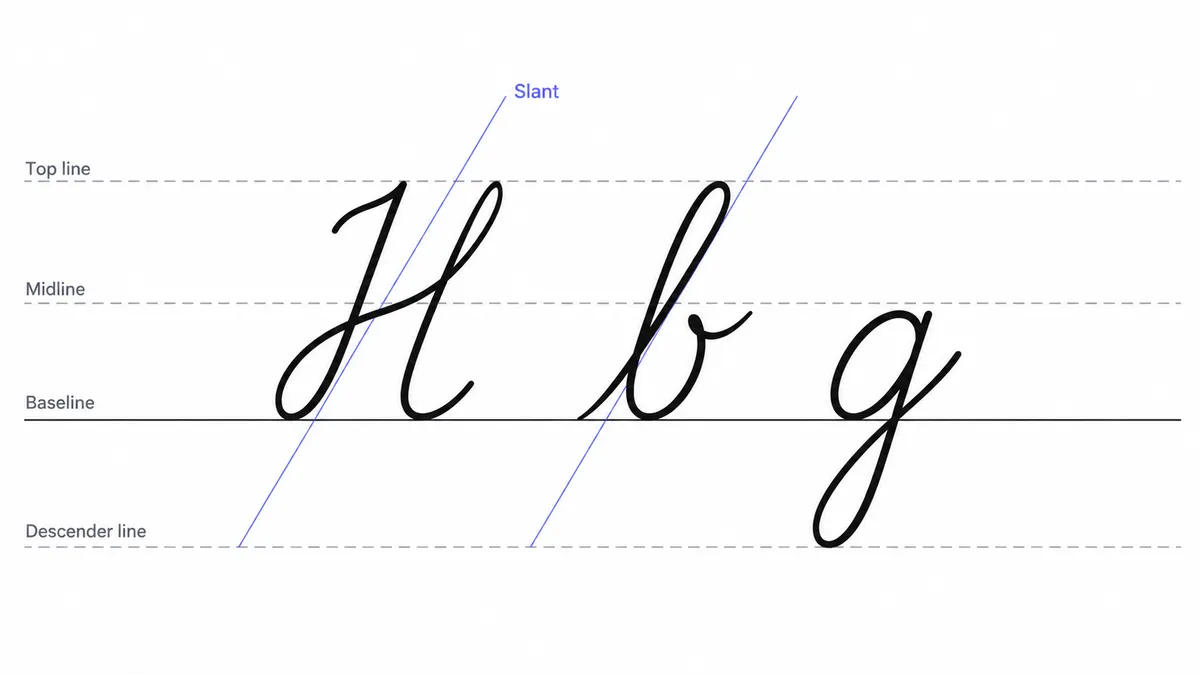
Even letter heights matter more for neat cursive than perfect individual shapes. The practice sheets on each letter page use these lines.
How do I get a steady slant, spacing and speed?
- Slant everything the same way. About 15–20° to the right is typical. Turn the paper so your writing arm moves naturally, rather than twisting your wrist.
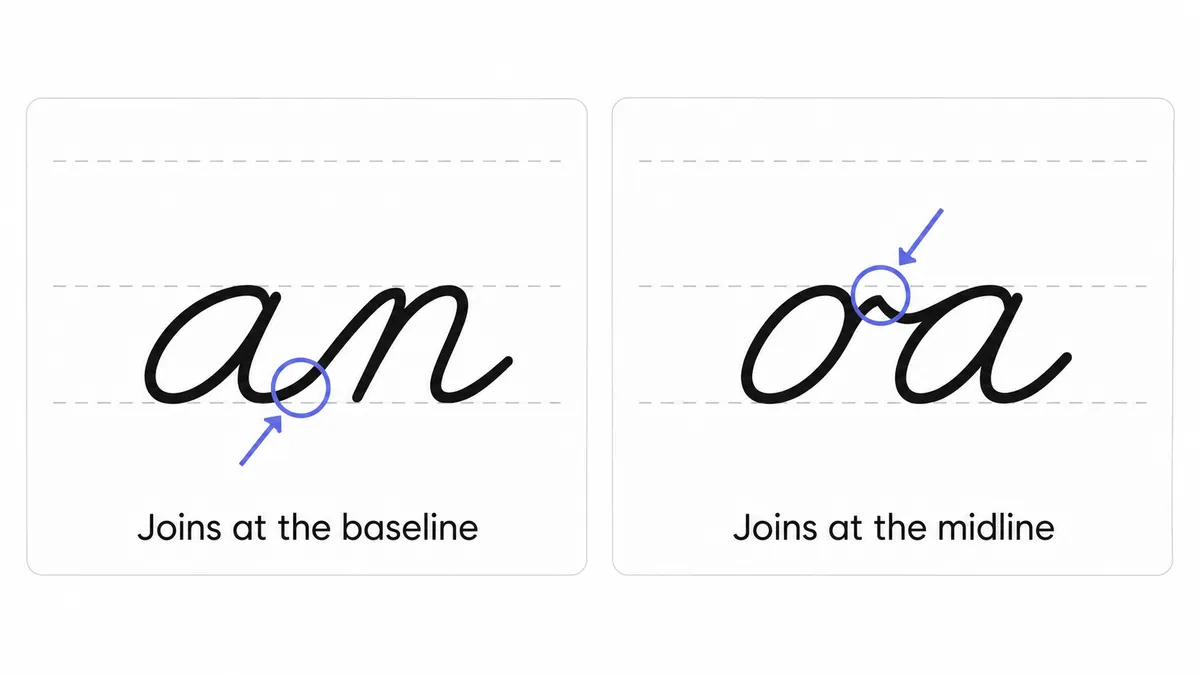
- Keep joins smooth, not tight. Cursive letters join with connecting strokes. Leave enough space that each letter is still distinct.
- Write slowly first. Accuracy builds speed. Rushing early locks in shapes that are hard to unlearn.
- Lift where the model lifts. Some capitals (O, V, W, and in many models B, D, F, G, I, P, Q, S, T) don’t connect to the next letter. Lifting your pen there is correct, not a mistake.
Where should I start?
Begin with the family table above, then branch out:
- Cursive lowercase letters: the 26 small letters in four families, with height zones and the joins that trip people up.
- Cursive capital letters: the 26 capitals grouped by first stroke, with notes on which ones connect.
- Cursive joins: the four ways one letter connects to the next.
- Words in cursive: real words by theme, so you can practise joins in context.
- Cursive sentences: short lines and pangrams to build an even hand.
- Cursive numbers: the digits 0 to 9 in cursive.
- Names in cursive: common first names, join by join.
- Months and days in cursive: capitalised words to practise.
Can I type in cursive instead of writing it?
These guides teach handwriting. If you want cursive-looking letters to paste into Instagram, a message or a design, use the cursive text generator, which builds cursive from Unicode characters. For other ways to get cursive on a phone or in Word and Google Docs, see how to type in cursive. Either way, the cursive letters on these pages are the place to learn the real shapes.